
Blotting Ink
Excerpt from Can Peacock’s Fly?: Journey Through a Broken Psyche • Written 2024

Author’s note: The scene below is from my 2023 hospitalization at Ridgeview. I wrote it later, in recovery, to make sense of what it felt like from the inside: the glass, the light, the needle, the breath. Names and some details have been changed. This is part of a larger memoir-in-progress about trauma, neurodivergence, grief, and the long work of healing and repair.
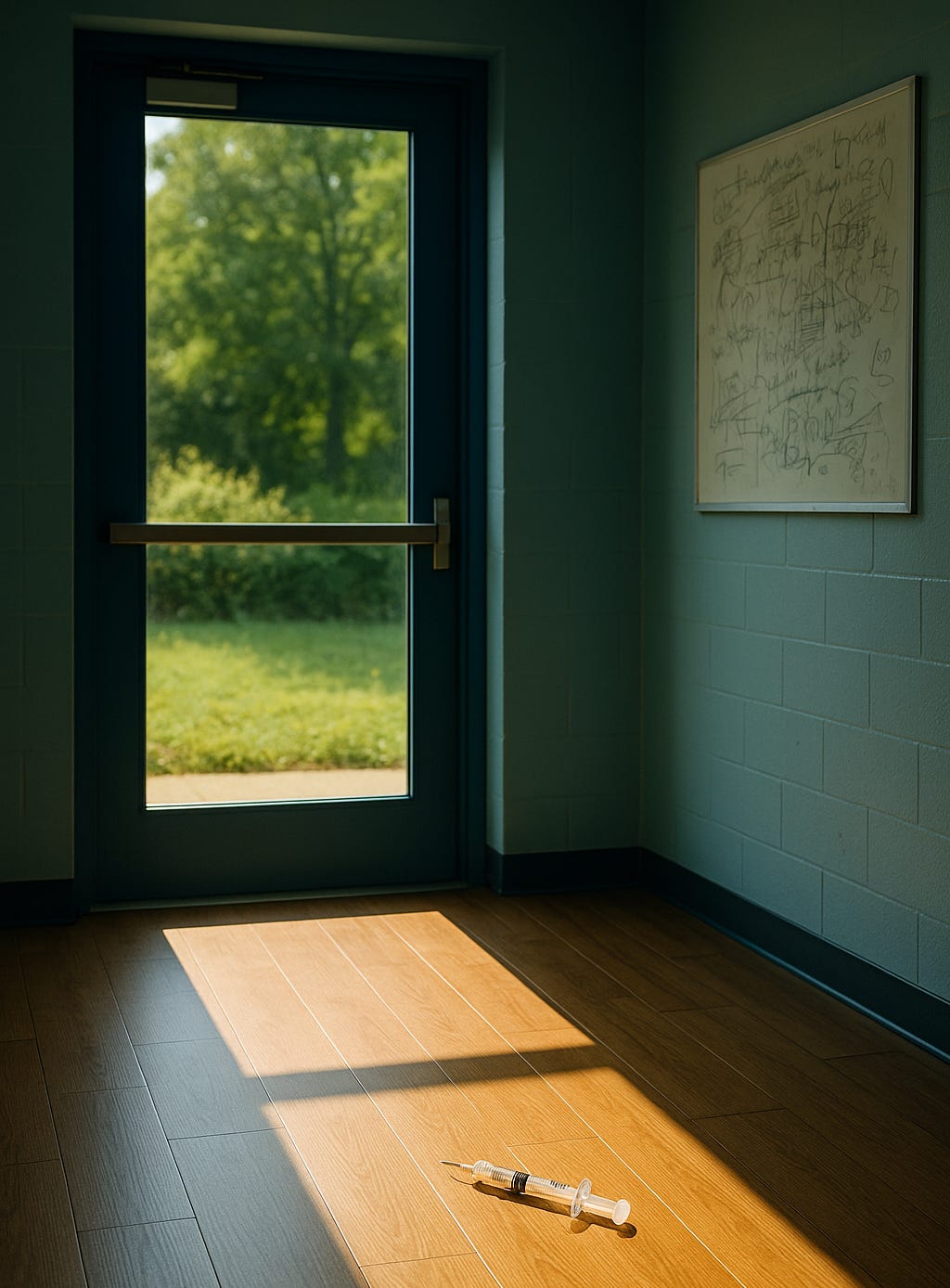
Like a cat, I lay stretched across the hard linoleum floor, soaking in the sun’s warm rays. I stared out through the door that always stayed locked, toward the outside world. Giant panes of unbreakable glass flooded the room with light from every direction—a cruel illusion of freedom.
And yet, in all my days by this door, I somehow managed to wedge it open just enough to pour a little water outside. A ritual. A summoning. With that water, I called for my rescue squad—magical family members with secret identities cloaked in fantasy. They never arrived, of course. They didn’t exist outside the prism of my mind.
I’m not sure “caged” is the right word for how I felt. There was space to roam, technically—but it was more like being on display, a zoo animal behind invisible bars. I could pace, wander, even drift into other worlds inside my mind. But the freedom was false. I was being watched. Analyzed. Contained.
I was dejected, my spirit threadbare. Those hours by the door were like an outdoor cat forced to live inside, pawing desperately at the glass for something that would never open.
Even if I managed to break through that side door, I’d just meet the walls of another building. A fence. Surveillance cameras. A rush of nurses and staff. And the next thing I’d feel would be the sharp burn of a needle in my arm, followed by the violent tremor of a seizure. Either a locked room—where I truly would be caged—or, if I was lucky, a chance to writhe in the stiff wooden chairs of the day room.
It hadn’t always been this calm. A few days earlier, I’d been a storm tearing through C Pod.
I hadn’t tried to escape that day—not exactly—but I had been running. I’d burst through the hallways, manic and muttering, barging into other people’s rooms, most notably in the women’s hall. Those of the opposite sex were forbidden to go to the others’ halls. I put on someone’s socks (I had no shoes and only one pair of my own), wrapped myself in a shawl I found, and clutched a Bible like a relic.
In the activity room, I scrawled strange symbols and sigils across the walls with marker and crayon—just like I had two years earlier at my parents’ house, the last time this happened.
I made animal noises. I laughed hysterically. I was a ballistic fireball.
Then I sat like a king as the others tried cleaning it off, including my newly acquainted friends Jennifer and Zaharah. Jennifer kept saying it was unfair they had to clean up my mess, but I wasn’t even on planet Earth enough to accept it was a mess or that it should be cleaned.
Then I wandered into someone else’s bathroom, still ranting and raving, convinced that today was the day Jesus would come to rescue his Angel.
The walls shimmered. Colors pulsed in strange hues. People looked overly saturated, like claymation—Chicken Run style or like looking through a fishbowl lens. The room spun, and so did I.
A knock came at the door.
Some of what I write is heavy. Some of it’s light.
But all of it’s honest.
If you like that kind of space, I’d be honored to have you here.
“Drew, you need to come out!” Called a nurse. Her voice was firm but laced with strained compassion—the way a nurse tries to be with an unruly patient.
“Just a second, I’m peeing!” I bellowed.
I tried to actually pee, while also tidying the horrific mess of the bathroom. Cleaning other people’s spaces is a go-to move of mine—a tangled reflex of mania and co-morbid obsessive compulsion. My therapist still brings up the first day I arrived at the homeless shelter he ran, how I started reorganizing the entire kitchen and leaving sticky notes on everything broken or expired. He jokes about how he kept finding new ones for weeks.
More time must have passed than I realized. The banging on the door intensified. Voices sharpened. I could hear their thinning patience.
Someone finally opened it—it wasn’t even locked (by design).
“Hold on! I can’t pee with y’all staring at me!” I shouted, still on the toilet as a man stood awkwardly in the doorway, holding it half-open.
Eventually, I did pee. Then I came out.
There was a whole group waiting for me.
“It’s time for your shot, Drew,” someone said. A nurse. Or a doctor.
I was so confused. Everything felt hazy, warped like a dream, time-lapsed. I hadn’t really slept in weeks. I didn’t know what was happening.
The next thing I knew, people were holding me down. I screamed at the contact. At the needle coming toward me. At the panic bubbling in my chest.
This is it, I thought. I’m getting the death penalty. I’m going to die here at Ridgeview, and they’re going to cover it up. No one will know what happened. Can Angels die?
The needle hit. The burn was immediate, searing. I screamed—loud enough to be heard across multiple pods. My blood felt like it was boiling. My skin itched and sizzled. I started convulsing. I saw terror flash across the staff’s faces—some of them backed away.
“WHY ARE YOU HURTING ME?! WHY! ARE! YOU! HURTING! ME?!”
I bolted from the room, even more unhinged than before. The staff shrank back, defeated, hoping for a different outcome. I was hyperventilating, spiraling, utterly convinced I was about to die. This was it—the death cocktail.
And then—amid the chaos—a nurse took my hands.
He was sweating, beautiful, and probably admired by every hypersexual patient in the ward, myself included.
“It’s okay, baby,” he said—or at least I think he said that. I might have hallucinated it.
“Just breathe.” He started counting my breaths. It helped.
It worked. My breath slowed. My heart still raced. My skin still burned. But I was no longer screaming.
He distracted me with conversation—said he’d spoken to my mom, told me he’d be going on vacation soon and to try not to get into trouble while he was gone. He was kind. And when I was finally discharged, he was the one who walked with me through Ridgeview’s endless, winding halls toward the front lobby to wait for my Uber.
The rest of that day, I sat in the day room like I usually did—only now, in pain. My arm throbbed like it had been torn open. Everyone felt bad for me. They tried to cheer me up. Most of the staff avoided my gaze. I glared back anyway, seething.
The shot hadn’t calmed me. It hadn’t helped me sleep. By the next day, it had just become part of the story.
I was the Archangel Michael. I had survived the death cocktail at Ridgeview Institute in Smyrna. I was now immortal. I had passed Jesus’ test. I was unstoppable.
Just a little more sprawling by the window now… until my next pounce.
And pounce again, I would.
Madness is a kind of ink: it spills, it stains, and it makes its mark.
Drew
This piece is a chapter excerpt from Can Peacocks Fly?: Journey Through A Broken Psyche—a memoir shaped by trauma, neurodivergence, grief, and the long, ongoing work of healing and repair. For more excerpts and content like this, consider subscribing to Writing Through Fire.